

The Great Shift in Australian Homeownership
For decades, the “Australian Dream” meant one thing — a large standalone home on a big block of land with a spacious backyard, multiple living rooms, and a white picket fence.
But in 2026, that dream is evolving.
Today’s younger buyers are rethinking what truly matters in a home. Rising property prices, changing work lifestyles, technology, environmental awareness, and shifting personal priorities are reshaping the Australian property market faster than ever before.
Across Melbourne and other major Australian cities, Millennials and Gen Z buyers are no longer chasing oversized luxury homes purely for status. Instead, they are prioritising flexibility, lifestyle, affordability, convenience, and long-term liveability.
The result?
A completely new definition of the modern Australian Dream.
Why the Traditional Australian Dream Is Fading
Australia’s housing market has undergone major transformations over the past decade.
Several factors are driving this change:
- Rising construction costs
- Higher interest rates
- Increased cost of living
- Longer commuting times
- Changing family structures
- Remote and hybrid work culture
- Environmental sustainability concerns
- Desire for work-life balance
For younger Australians, buying a massive home in an expensive inner-city suburb is becoming less realistic — and in many cases, less desirable.
Instead, buyers are asking:
- “Can this home improve my lifestyle?”
- “Can I work comfortably from home?”
- “Is this location connected and community-focused?”
- “Will this property still suit me in 10 years?”
- “Can I enjoy life without financial stress?”
These questions are changing the direction of Melbourne’s property market.
1. Smaller Homes Are Becoming More Popular
Bigger is no longer always better.
Young Australians are increasingly choosing:
- Compact homes
- Functional floorplans
- Townhouses
- Low-maintenance properties
- Smartly designed smaller lots
Why?
Because modern buyers value efficiency over unused space.
A well-designed 3-bedroom townhouse with modern features and low maintenance often feels more practical than a large house requiring endless upkeep.
Why Smaller Homes Appeal to Young Buyers
Lower Maintenance
Smaller homes require less cleaning, fewer repairs, and lower maintenance costs.
Better Affordability
Buyers can enter the property market sooner without overstretching financially.
Energy Efficiency
Compact homes generally consume less electricity and water.
Location Advantage
Instead of buying a large home far away, buyers can choose smaller homes closer to schools, transport, shopping, and lifestyle hubs.
In Melbourne’s growth corridors, developers are increasingly focusing on:
- Smart land usage
- Functional living spaces
- Integrated communities
- Sustainable designs
This trend is expected to continue strongly over the next decade.
2. Work-From-Home Spaces Are Now Essential
The pandemic permanently changed how Australians work.
Remote and hybrid work arrangements are now common across industries, and homebuyers are actively searching for properties that support productivity and comfort.
Today’s buyers want:
- Dedicated home offices
- Quiet study spaces
- Fast internet infrastructure
- Flexible multi-purpose rooms
- Natural lighting for video meetings
A spare bedroom is no longer just a guest room.
It is now:
- An office
- A business space
- A creative studio
- A remote work hub
The Rise of Functional Design
Builders and developers are adapting quickly by incorporating:
- Study nooks
- Flexible floorplans
- Built-in office spaces
- Acoustic insulation
- Multi-use living areas
This shift is especially visible in Melbourne’s outer suburbs, where newer developments offer larger internal functionality at more affordable prices.
3. Smart Homes Are Becoming the New Standard
Technology is playing a huge role in shaping buyer expectations.
Modern Australian buyers increasingly expect homes to include smart technology features that improve:
- Security
- Energy efficiency
- Convenience
- Connectivity
Popular Smart Home Features
- Smart lighting systems
- Video doorbells
- Remote-controlled security cameras
- Smart air conditioning
- Voice-controlled assistants
- Smart locks
- Energy monitoring systems
- Solar integration
Younger buyers see smart homes as:
- Future-ready
- Cost-efficient
- Safer
- More environmentally responsible
Developers who include technology integration are gaining stronger interest from younger purchasers.
4. Community Living Is More Important Than Ever
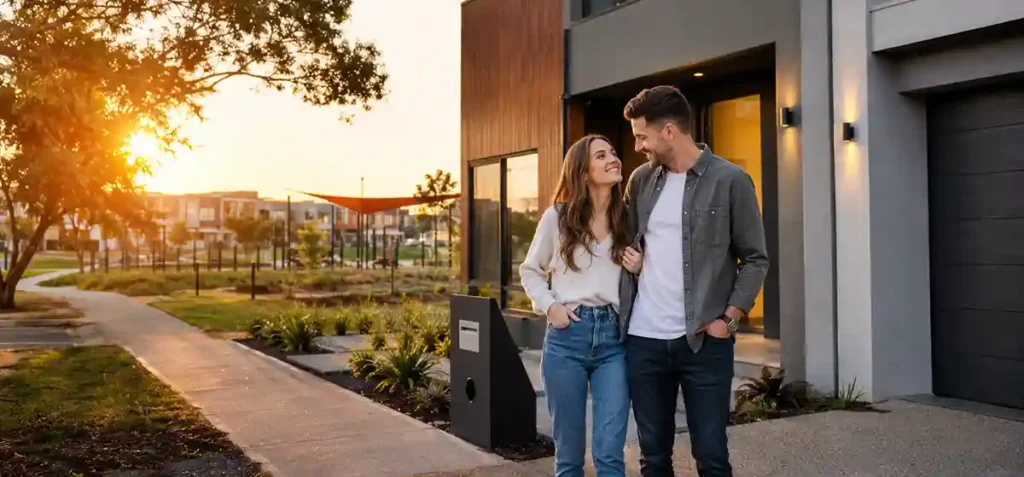
One of the biggest shifts in modern homebuying is the growing desire for community-focused living.
Buyers are no longer choosing homes based solely on the property itself.
They are evaluating:
- The neighbourhood
- Local lifestyle
- Community atmosphere
- Walkability
- Nearby amenities
- Green spaces
- Schools
- Cafés
- Recreation areas
Modern Buyers Want Connection
New master-planned communities across Melbourne are becoming highly attractive because they offer:
- Parks
- Schools
- Shopping precincts
- Walking tracks
- Sporting facilities
- Childcare centres
- Community events
People want to feel connected — not isolated.
This is particularly important for:
- Young families
- First-home buyers
- Remote workers
- Migrants relocating to Australia
The emotional side of homeownership is becoming more important than ever.
5. Lifestyle Is Replacing Luxury
Luxury used to mean:
- Large mansions
- Expensive finishes
- Prestige suburbs
- Oversized entertainment spaces
Now, luxury means something very different.
For younger Australians, real luxury often means:
- More personal time
- Less financial pressure
- Better work-life balance
- Shorter commutes
- Access to nature
- Flexibility
- Mental wellbeing
Many buyers would rather:
- Live near parks and cafés
- Have flexible working arrangements
- Enjoy community activities
- Travel more often
- Reduce debt stress
instead of owning an oversized property with massive ongoing expenses.
This mindset shift is redefining how properties are marketed across Australia.
6. Outer Suburb Migration Is Accelerating
One of the strongest trends in Melbourne’s property market is the movement toward outer suburbs and growth corridors.
Areas once considered “too far” are now attracting significant interest due to:
- Better affordability
- Larger land opportunities
- New infrastructure
- Improved transport
- Modern housing estates
- Better value for money
Why Young Buyers Are Moving Outward
Buyers are discovering they can achieve:
- Better lifestyle balance
- Larger living spaces
- Newer homes
- Family-friendly environments
- Strong future growth potential
without paying inner-city premium prices.
Melbourne growth suburbs continue to attract:
- First-home buyers
- Investors
- Young families
- Migrants
- Remote workers
This trend is reshaping Victoria’s property landscape.
What This Means for the Future of Australian Real Estate
The future of Australian housing is becoming:
- Smarter
- More flexible
- More sustainable
- Lifestyle-driven
- Community-focused
Developers, builders, and property professionals who understand these changing buyer priorities will be best positioned for long-term success.
The younger generation is not abandoning the Australian Dream.
They are simply redefining it.
And that new dream focuses less on size and status — and more on freedom, wellbeing, flexibility, and meaningful living.
Final Thoughts
The Australian property market is entering a new era.
Young buyers are reshaping the industry through changing expectations, lifestyle priorities, and smarter financial decisions.
Homes are no longer judged only by:
- Square metres
- Prestige
- Luxury finishes
Instead, people now prioritise:
- Liveability
- Flexibility
- Smart design
- Community
- Sustainability
- Long-term lifestyle value
For property investors, developers, and homebuyers, understanding this shift is essential.
Because the future of Australian real estate belongs to properties that support how people truly want to live.