Australian New Home Sales Decline, Raising Supply Concerns
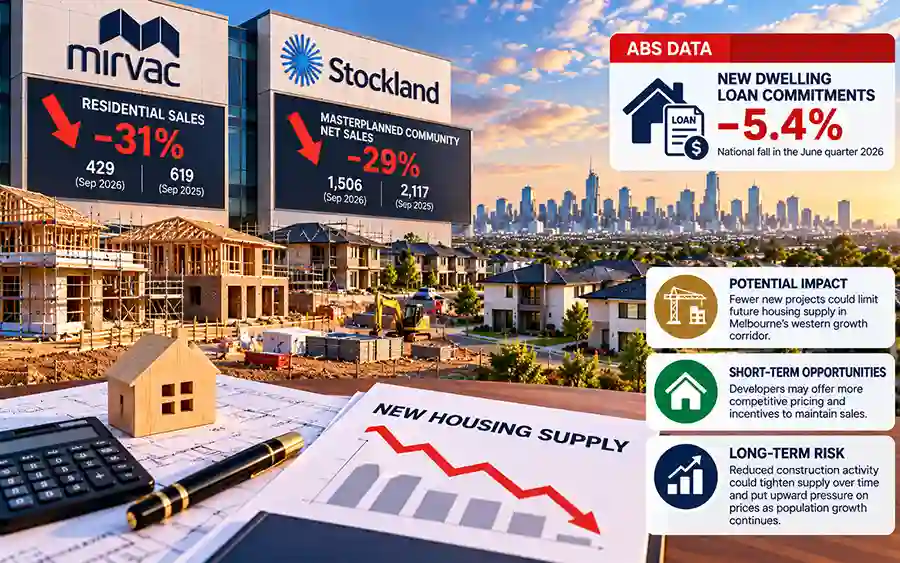
Australia’s new-housing market is showing signs of strain, with major developers reporting weaker residential sales as higher interest rates and reduced borrowing capacity weigh on buyer demand.
Mirvac recorded 429 residential sales in the September 2026 quarter, down from 619 a year earlier. Stockland also reported softer conditions, with masterplanned-community net sales falling to 1,506 from 2,117 a year earlier.
The lending market is also cooling. Australian Bureau of Statistics data show the number of new dwelling loan commitments fell 5.4% nationally in the June quarter, while investor loan commitments dropped 8.6%.
For Melbourne’s western growth corridor, weaker new-home demand matters because many communities depend on a steady flow of land sales, house-and-land purchases and pre-sales to keep new projects moving.
If sales remain subdued, some developers may delay future stages, reduce the pace of land releases or become more cautious about launching new projects. Over time, that could limit the amount of new housing reaching the market.
The picture is not entirely negative. ABS building data show total dwelling commencements actually rose 7% in the June quarter, including an 11.6% increase in private-sector house starts. This means the immediate construction pipeline remains active, even though weaker sales could affect projects further ahead.
For buyers in Melbourne’s west, slower sales may create short-term opportunities. Developers may offer more competitive packages, incentives or flexible terms to maintain sales momentum.
The longer-term risk is different. If weak demand today results in fewer projects being launched tomorrow, housing supply could tighten just as population growth continues.
Investors should therefore look beyond current price conditions and consider the strength of each estate’s development pipeline, infrastructure delivery, rental demand and surrounding employment growth.
Overall, softer sales at major developers and weaker lending point to a more cautious new-housing market. For Melbourne’s western growth corridor, that could mean better buying conditions in the near term, but potentially tighter supply later if development activity slows too far.
Summarised by Ravs Realtors from reporting by Brokernews.