Maylands WA Property Market Sees Strong Growth
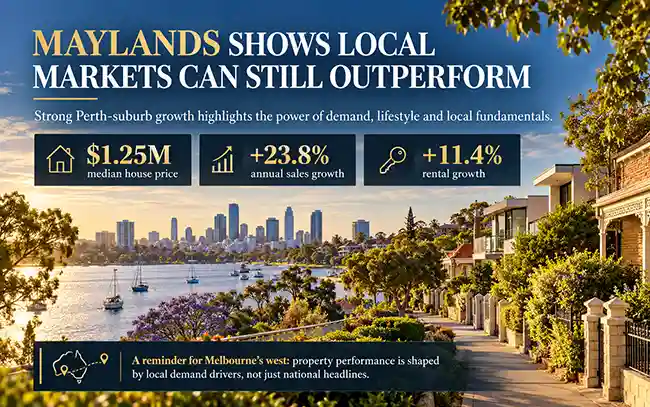
While many Australian property markets are experiencing softer conditions, Maylands in Western Australia is showing that strong local fundamentals can still support significant price and rental growth.
According to REIWA data for the 12 months to September 2026, Maylands recorded a median house price of $1.25 million, with annual sales price growth of 23.8%. Median house rents also reached $780 per week, representing rental growth of 11.4% over the year.
The result stands out at a time when national dwelling values have been under pressure from higher interest rates and reduced borrowing capacity. It demonstrates that the broader housing downturn is not affecting every suburb in the same way and that local supply, demand, lifestyle appeal and buyer competition can produce very different outcomes.
Maylands benefits from a combination of factors that help support demand. It is located close to Perth, has established transport links, local shopping, parks and schools, and offers a mix of houses and units that appeal to both owner-occupiers and investors. REIWA reports that houses in the suburb are selling relatively quickly, with a median time on market of around 13 days.
Rental demand has also remained strong. Higher rents can improve returns for existing landlords and make the area more attractive to investors, although purchase prices and borrowing costs still need to be considered carefully when assessing overall yield.
For Melbourne’s western growth corridor, the Maylands example is a useful reminder that national headlines do not tell the full story. Even when the broader market is weakening, individual suburbs can outperform if they have the right combination of affordability, infrastructure, employment access, population growth and limited supply.
This means buyers and investors should focus on local market data rather than assuming every suburb will move in line with Melbourne or national averages. A suburb with strong rental demand, improving amenities and constrained housing supply may perform differently from another area only a short distance away.
For investors in Melbourne’s west, this places greater importance on rental yield, vacancy rates, new housing supply and long-term demand drivers. Areas supported by transport upgrades, schools, shopping centres, employment precincts and population growth may be better positioned to remain resilient through a softer market cycle.
For sellers, the lesson is also important. Properties in areas with strong local demand can still achieve good results even when broader market sentiment is cautious. Presentation, realistic pricing and understanding the specific buyer pool remain critical.
Maylands also highlights the role of affordability within a wider metropolitan market. Buyers may shift toward suburbs that offer better value while still providing access to employment, transport and lifestyle amenities. Similar behaviour could support selected locations in Melbourne’s western growth corridor if buyers continue to prioritise value for money.
Overall, Maylands shows that Australia’s property market is increasingly fragmented. Some areas are correcting, while others continue to record strong growth due to local conditions. For buyers and investors in Melbourne’s west, the strongest opportunities are likely to come from understanding suburb-level fundamentals rather than relying solely on national market trends.
Summarised by Ravs Realtors from reporting by Reiwa.